
Futamichoe, Ise, Mie Prefecture –
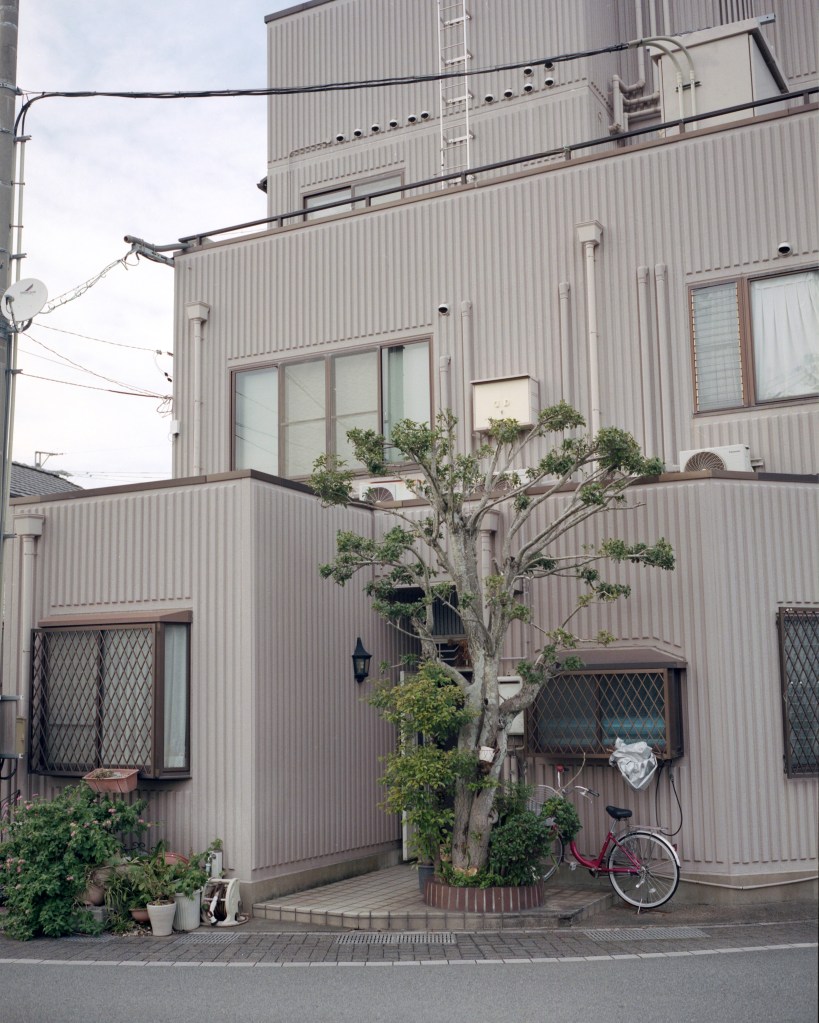
To reach Meoto Iwa, you must disembark at the Futamino Ura station and walk toward the coastline for about twenty minutes. Pass beneath the torii gate and take the main road just in front of the station. On your left, at the corner, you’ll spot a gray house with a small tree near the entrance. There’s always at least one bicycle parked under the window. As you continue through the village, you’ll eventually arrive at the sea. Follow the road eastward until you reach the white torii gate that marks the entrance to the Futamiokitana temple. After a few meters, you’ll catch your first glimpse of the two rocks among the others, but don’t stop there; the best view is a bit further ahead.
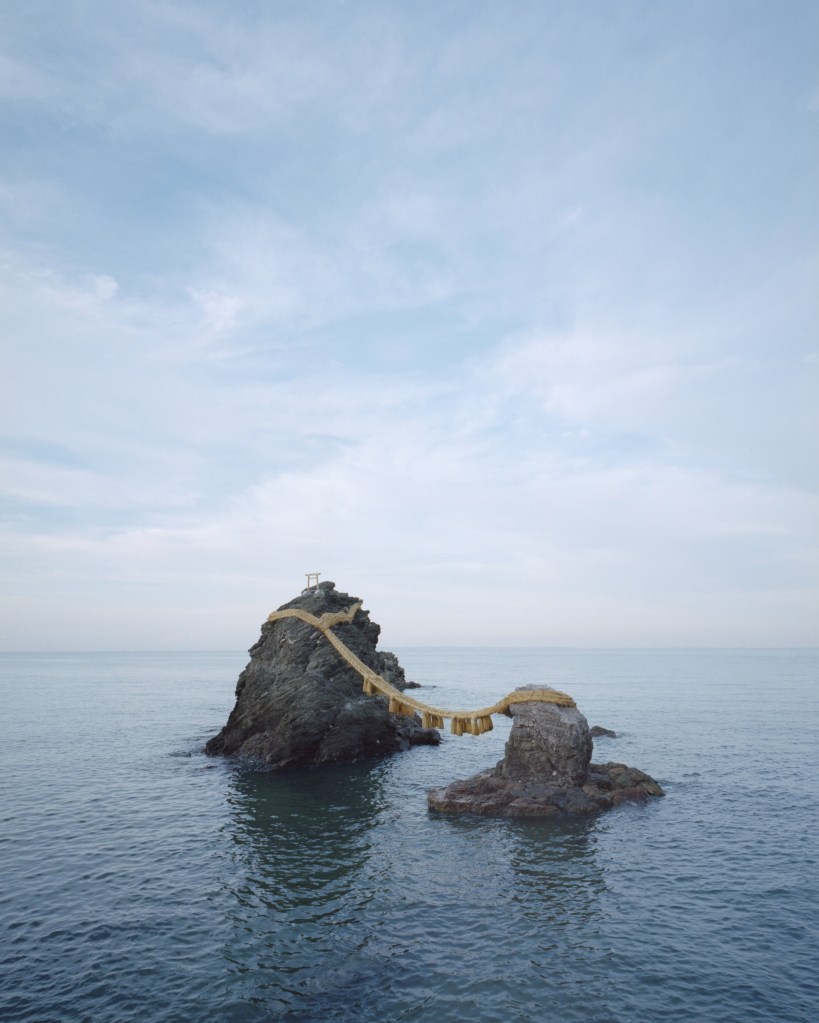
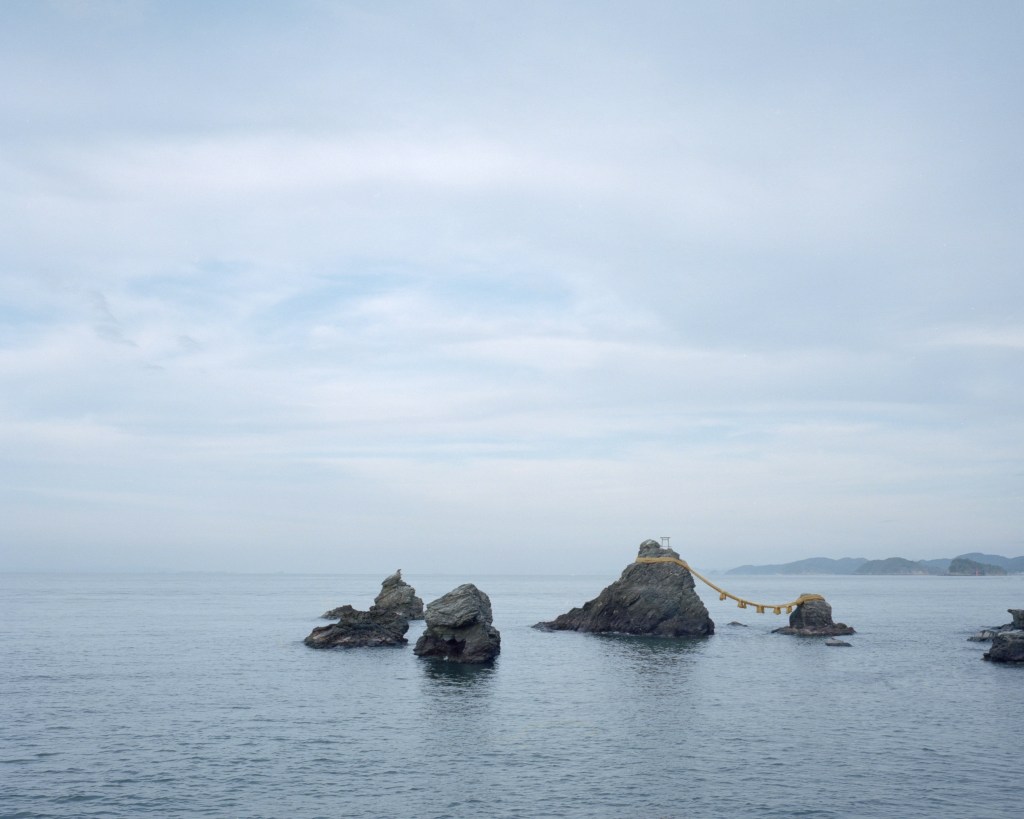
Upon our arrival, the sun begins its descent toward the horizon, and the blue sky rapidly transforms into shades of yellow and then orange. We decide to wait for the sunset, and the only thing to do is to fix our gaze upon the two rocks, which are much smaller than I had anticipated, linked by a rope. Meoto Iwa is a sacred place, symbolizing the union of the two creator deities of the land, Izanagi and Izanami. Husband and wife, they used their spear to raise the islands that became the land of Yamato, Japan. From them, all other gods, both benevolent and malevolent, were born, and the legend narrated in the Kojiki is filled with unexpected twists. In Shinto, the two rocks are considered Iwakura, a term used to identify rocks that serve as Yorishiro, which are catalysts that attract the kami, giving them a physical space to inhabit during religious ceremonies. The rope that binds them is called a shimenawa and is a seal signifying the object’s sanctity. In Shinto, Yorishiro are often trees, large stones, as well as swords, mirrors, magatama (bean-shaped decorative items), or gohei (wooden wands). In everyday life, many other objects are used as physical forms of spiritual power; one of the most well-known to Westerners is the maneki-neko.
I remain still, observing the two rocks for a long time. It’s a sight that encapsulates all of Japan in a single glance. The empty space between them evokes the aesthetic of zen gardens, while the rope and the small torii above one of them tell of faith and a strong sense of community. The symbolic value they hold, as the creators of all the islands, their enduring love even after destiny separated them, washes over like the relentless waves breaking on the shore. It’s like staring Japan in the face, contradictions included. It would have been better if they were of the same size, weight, and volume, husband and wife. Instead, “she” appears to bear the weight of “him.”
The sea fades into an increasingly deep shade of blue as the sun descends below the horizon, and a sudden breeze blows over us. I’ve taken only two photographs, but that’s enough for me. I’ve imprinted one in my mind, gazing fixedly at the sea swirling around these two rocks that people have decided are the origin of everything – of the land from which the sun rises.
We board the last train to Nagoya, where a couple sleeps in the blue seats, holding hands. Just like the rope – I think – and the see all around.
Scogli mano nella mano ( versione originale )
Per raggiungere Meoto-Iwa dovete scendere alla stazione di Futamino Ura e camminare verso la costa per una ventina di minuti. Passate sotto al torii e prendete la strada principale davanti alla stazione, sulla vostra sinistra all’angolo vedrete una casa grigia con un piccolo albero davanti all’ingresso, c’è sempre almeno una bicicletta parcheggiata sotto alla finestra. Proseguendo per il paese arrivate fino al mare e seguite la strada verso est fino al torii bianco che segna l’ingresso al tempio Futamiokitana. Dopo pochi metri riuscirete a vedere i due scogli tra altri ma non fermatevi, la vista migliore è più avanti. Superate il tempio e avrete a pochi metri la visuale migliore.
Quando arriviamo il sole sta iniziando a scendere verso l’orizzonte, il cielo azzurro diventa velocemente giallo, poi arancione. Decidiamo di attendere il tramonto e l’unica cosa da fare è fissare le due rocce – molto più piccole di quanto mi aspettassi – legate da una corda. Meoto Iwa è un luogo sacro, rappresenta l’unione delle due divinità creatrici del paese: Izanagi e Izanami. Marito e moglie che con la loro lancia fecero sorgere le isole che divennero la terra di Yamato, il Giappone. Da loro nacquero anche tutti gli altri dei – buoni e cattivi – e la leggenda narrata nel Kojiki è piena di colpi di scena. I due scogli sono considerati nello scintoismo un Iwakura, il termine per identificare le rocce che sono un Yorishiro e cioè dei catalizzatori che attraggono i kami ovvero gli dei, dando loro uno spazio fisico da occupare durante le cerimonie religiose. La corda che li unisce è detta shimenawa ed è un sigillo che manifesta la sacralità dell’oggetto. Nello scintoismo gli yorishiro sono spesso alberi, grossi massi ma anche spade, specchi, magatama ( oggetti ornamentali dalla forma di un fagiolo) o gohei ( bacchette di legno ). Nella quotidianità molti altri oggetti vengono usati come forma fisica di un potere spirituale, il più noto agli occidentali sono i maneki-neko, i gattini con la zampa alzata che via accolgono all’ingresso di negozi o ristoranti.
Rimango fermo ad osservare i due scogli per molto tempo. É il Giappone in un solo colpo d’occhio. Lo spazio che li divide rimanda all’estetica del vuoto dei giardini zen. La corda racconta il forte senso di comunità ( viene realizzata dai fedeli e sostituita ogni anno). Il torii è come un ideogramma che rappresenta tutto quello che puoi trovare qui. Il senso di Meoto-iwa ( marito e moglie – divinità creatrici di tutte le isole – il cui amore li unisce per sempre ) arriva costante, perpetuo come le onde che si infrangono a riva. È come guardare il Giappone in faccia – penso – contraddizioni comprese. Sarebbe stato meglio fossero della stessa dimensione, peso e volume marito e moglie. Invece “lei” sembra sopportare la presenza incombente di “lui”.
Il mare appassisce diventando sempre più nero, mentre il sole supera l’orizzonte e un vento improvviso ci soffia addosso. Ho scattato due fotografie ma mi basta così. Ne ho impressa una nella mente guardando fisso il mare che gira intorno a questi due scogli che sono l’origine di tutto – del paese da cui sorge il sole.
Saliamo sull’ultimo treno per Nagoya. Una coppia dorme seduta sui sedili blu tenendosi per mano. Come la corda – penso – e intorno il mare.
 Nipponia Magazine